There is a moment — it comes to almost every visitor — somewhere between the military briefing room and the first stretch of barbed wire fence, when the abstract becomes concrete. You have known about this place. You have read about it. You may have seen it in documentaries, in news footage, in the background of political speeches. But standing here, looking north across a valley that has been emptied of people for more than seventy years, the Korean DMZ stops being a concept and becomes something you feel in the body.
The Korean Demilitarized Zone — the DMZ — is one of the most visited, most photographed, and least understood places on earth. It runs 250 kilometers across the Korean peninsula, four kilometers wide, roughly bisecting the land at the 38th parallel. It has been in place since the signing of the Korean Armistice Agreement in July 1953 — an agreement, notably, that ended the fighting but not the war itself. Technically, the Korean War has never formally ended. The DMZ is the physical expression of that unresolved state, and it has held its position, tense and frozen, for over seven decades.
Every year, hundreds of thousands of visitors — South Korean citizens, international tourists, journalists, diplomats, and scholars — travel to the southern edge of the DMZ to see it for themselves. Some come out of historical curiosity. Some come because they have family roots in what is now North Korea, severed by the division. Some come because they have watched too many political thrillers and want to see whether it is as dramatic as it looks on screen.
It is. And it isn't. And the reality is more complicated and more affecting than either.
ㅤㅤㅤㅤㅤㅤ
Before You Go: Understanding What the DMZ Is (and Isn't)
The name is, in many ways, a misnomer. The Korean Demilitarized Zone is one of the most heavily militarized places on earth. Both sides of the border are fortified with landmines, surveillance equipment, and armed soldiers. The four-kilometer buffer zone was established to separate the opposing forces — but the land directly adjacent to it, on both sides, is packed with military infrastructure.
What the DMZ is, ecologically, is something unexpected and quietly extraordinary: because humans have been effectively excluded from the zone for more than seventy years, it has become one of the most significant wildlife refuges in East Asia. Endangered species including the Amur leopard, the Asiatic black bear, the red-crowned crane, and the white-naped crane have been documented within the zone. The area is a conservation scientist's paradox — a region preserved by conflict rather than by policy.
Politically, the DMZ remains the most volatile border on earth. North Korea is one of the world's most opaque and heavily armed states, and the peninsula has seen real military incidents — including naval skirmishes, artillery exchanges, and infiltration attempts — in the decades since the armistice. Visiting the DMZ is not dangerous in the way a conflict zone would be. But it is not entirely ordinary either. Soldiers are present. Rules are enforced. And the atmosphere carries a weight that no amount of tourist signage can fully dissolve.
Understanding this — that you are visiting a place that is simultaneously a historical site, a living military installation, a strange ecological haven, and the frontline of one of the world's last Cold War standoffs — is the best preparation for the experience.
ㅤㅤㅤㅤㅤㅤ
How to Actually Visit: Tours, Access, and What to Expect
The DMZ is not a place you can simply drive to and explore independently. Access to the area is controlled by the South Korean military, and most visitors join organized tours that operate under specific permissions and follow set routes. This is not a bureaucratic inconvenience — it is the nature of the place. Parts of the surrounding area remain actively mined. Military escorts are not a formality.
ㅤㅤㅤㅤㅤㅤ
Tour Options from Seoul
The majority of DMZ tours depart from Seoul and take between five and eight hours depending on the sites visited. Several well-established tour operators — including USO Tours (which runs tours for both military personnel and civilians), Panmunjom Travel Center, and various licensed travel agencies — offer daily departures.
Tours generally fall into two categories:
DMZ-only tours cover the main civilian-accessible sites along the southern edge of the zone: the Third Infiltration Tunnel, Dora Observatory, Dorasan Station, and the Imjingak area. These tours are accessible to most visitors and give a thorough introduction to the history and physical reality of the border.
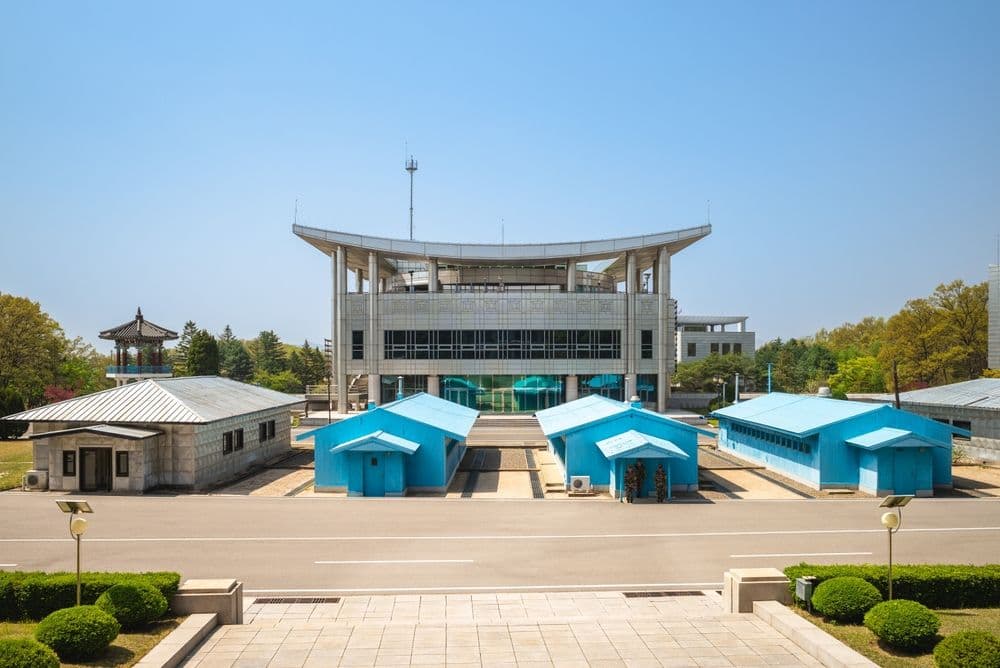
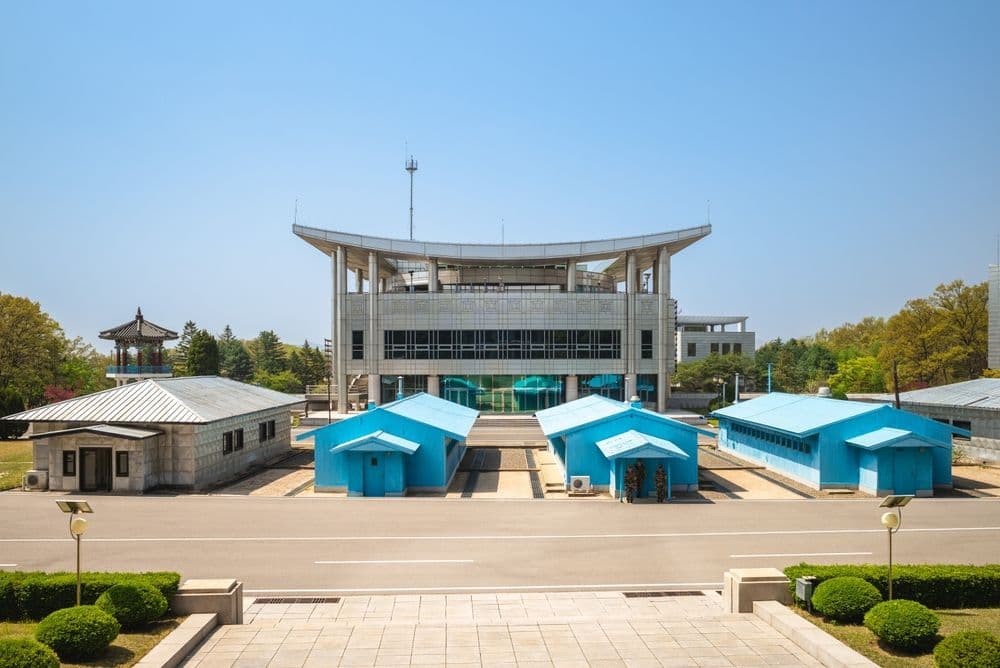
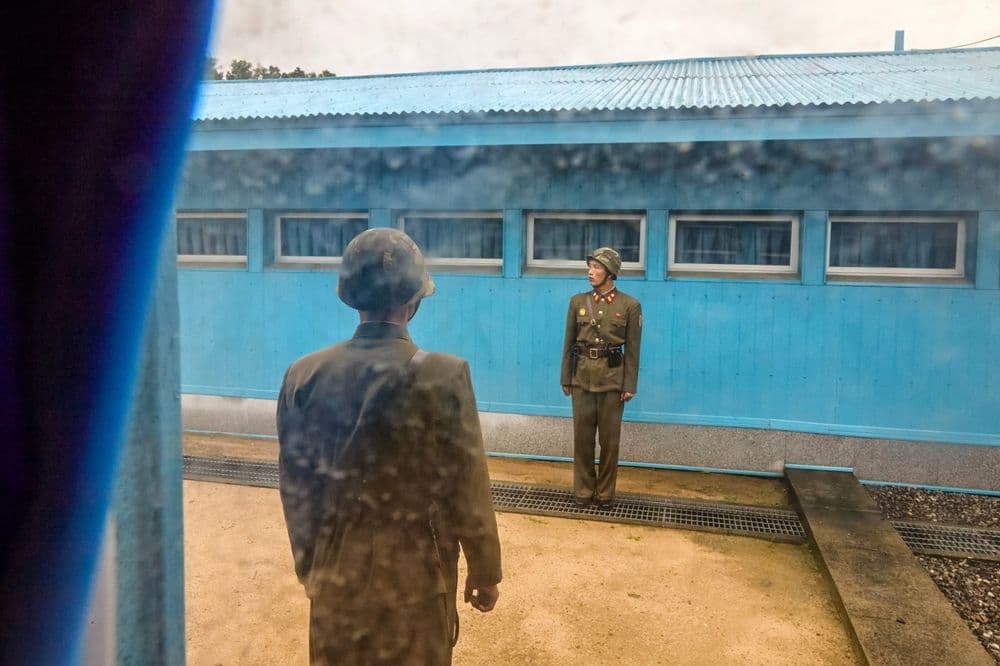
JSA (Joint Security Area) tours — commonly called Panmunjom tours — take visitors into the Joint Security Area, the small patch of ground on the Military Demarcation Line where North and South Korean soldiers stand facing each other across a low concrete curb. This is the location famous from countless photographs: the blue UN conference buildings straddling the border, the North Korean guards visible a few meters away, and the surreal sense of standing at the precise geographic point where two worlds meet.
JSA tours require advance booking, passport registration, and approval through the United Nations Command. They also come with a strict dress code — revealing clothing, ripped jeans, and sandals are prohibited; the logic is that visitors to the JSA are, in a protocol sense, representing the UN's presence there. The rules feel unusual until you are standing in the conference room with one foot technically in North Korea and the other in South Korea, at which point the seriousness of the space becomes immediately self-evident.
Important note: JSA tour availability has been subject to periodic suspension due to inter-Korean tensions. Before booking, always check current availability with your tour operator, as conditions can change with relatively little notice.
ㅤㅤㅤㅤㅤㅤ
The Key Sites: What You Will Actually See
The Third Infiltration Tunnel
Discovered in 1978 — the third of four known tunnels dug by North Korea under the DMZ — this is one of the most viscerally striking experiences of any DMZ visit. The tunnel descends at a steep angle into the earth, eventually reaching a depth of about 73 meters. It is wide enough for infantry to march through four abreast, and North Korean engineers had constructed it with military purpose: at its designed capacity, the tunnel could have allowed approximately 30,000 soldiers per hour to pass through into South Korea.
Visitors walk down into the tunnel in hard hats, crouching slightly in the lower-ceilinged sections, and reach a barrier about 170 meters from the Military Demarcation Line. The passage beyond is sealed. The tunnel smells of stone and cold air and carries an atmosphere that no reconstruction or museum exhibit could replicate — a concrete reminder, quite literally underground, of the active threat posture that has defined this peninsula for decades.
North Korea, when the tunnel was discovered, claimed it was a coal mine. The walls had been painted black to support this claim. There is no coal in the geology of that area.
Dora Observatory (도라전망대)
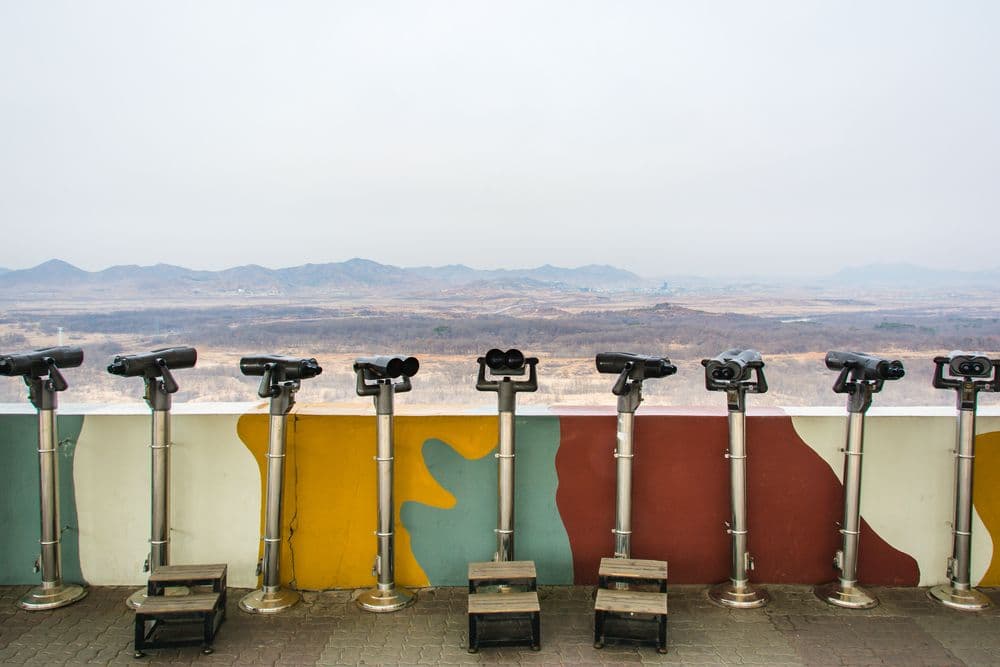
Perched on a hillside near the northernmost point of civilian access, Dora Observatory offers the clearest and most open view of North Korea available to the general public. On clear days, you can see the North Korean city of Kaesong — an industrial city of several hundred thousand people — and the mountains beyond it. Through the coin-operated binoculars, distant movement is sometimes visible: vehicles, what might be agricultural equipment, shapes that resist easy identification.
What strikes most visitors is not the drama of what they see but the profound emptiness of it. The hills rolling away to the north look, in many ways, like the hills to the south. But the villages that should be visible are absent or eerily sparse. The infrastructure is different. And the knowledge of what is behind those mountains — what kind of state governs the lives of the twenty-five million people who live there — lends the landscape a heaviness that is impossible to fully articulate.
A large painted arrow on the observatory's terrace points north and reads: Seoul 62km / Pyongyang 167km. Both cities are closer to each other than the width of many countries. Standing between those two distances, looking north, is one of the more concentrated geopolitical experiences available to a civilian traveler.
Dorasan Station (도라산역)
Perhaps the most poignant site in the entire DMZ area, Dorasan Station is a fully functioning, immaculately maintained railway station — and a train has not departed for its intended northern destination in years. Built in 2002 as part of a period of inter-Korean engagement and economic cooperation, the station was designed to connect Seoul to Pyongyang and ultimately to a trans-Siberian railway link that would have made Korea a transit point between East Asia and Europe.
The departure board still lists Pyongyang as a destination. The platform is clean, the facilities are operational, and the surrounding area has been designed with the architecture of possibility — a physical bet, now long frozen, on a future that has not arrived.
Visiting Dorasan feels less like sightseeing and more like reading a letter that was never sent. The station is not melancholy in a heavy way — it is melancholy in the way of things that were genuinely hopeful and remain genuinely unresolved. Most visitors spend a few quiet minutes on the platform, looking north along the track, before the tour guide calls them back.
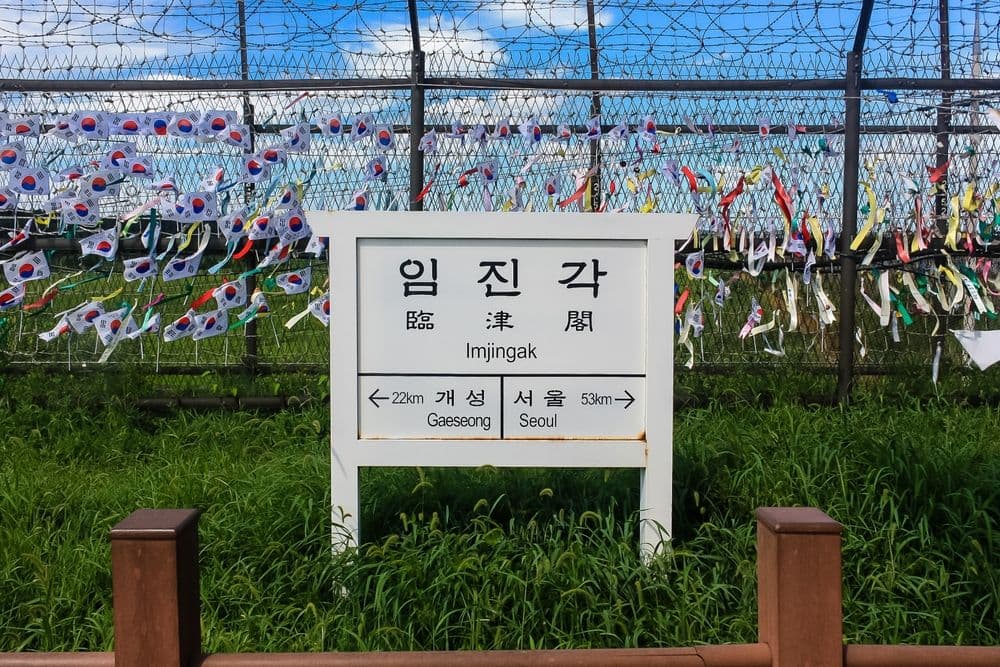
Imjingak (임진각)
Located just south of the DMZ, Imjingak is a public park and memorial complex that serves as the primary gathering point for South Koreans — particularly those with family origins north of the border — to perform memorial rites and pay respects to relatives they cannot visit. The park contains the Freedom Bridge (자유의 다리), across which 12,773 POWs walked south following the armistice in 1953. It is draped, year-round, with ribbons, fabric strips, and small personal tokens left by families separated by the division — a practice that transforms an ordinary railing into something that functions almost as a wailing wall.
The emotional register of Imjingak is different from the other DMZ sites. The tunnels and observation decks feel historical and geopolitical. Imjingak feels personal. The separation of families by the division — an estimated five to ten million people were divided from relatives — is an open wound in Korean society that has never fully healed, and at Imjingak the evidence of this is visible, physical, and recent.
ㅤㅤㅤㅤㅤㅤ
The Atmosphere: What It Actually Feels Like
Visitors consistently report the same phenomenon: the DMZ is stranger and more affecting than they expected, but not in the way they expected.
It is not terrifying. There is no active threat during a tour and visitors are never in danger. The military presence is professional and precise rather than aggressive. The landscape is, in parts, strikingly beautiful — rolling hills, the wide silver curve of the Imjin River, forested ridgelines that would be unremarkable anywhere else.
What makes it affecting is the weight of the context pressing against the quiet. You are standing in a place shaped entirely by the inability of human politics to resolve itself — a place where millions of people were separated, where a country was cut in two, where the unfinished business of a war that claimed between two and four million lives continues to exert its force on the present day. The barbed wire is not dramatic. It is mundane. And somehow that mundanity — the way this extraordinary geopolitical reality has become routine infrastructure — is more unsettling than anything theatrical could be.
Almost everyone comes away quieter than they arrived.
ㅤㅤㅤㅤㅤㅤ
Practical Tips for Visiting
Book in advance. Popular tours — especially JSA tours — fill up quickly and require advance registration. Book at least a week ahead for standard tours, two or more weeks for JSA tours during peak travel seasons.
Bring your passport. A valid passport is required for all DMZ tours. Entry is not permitted without it. Copies are not accepted.
Dress appropriately. Particularly for JSA tours, follow the dress code strictly. Business casual is a safe baseline. Avoid sleeveless tops, shorts, ripped clothing, and open-toed shoes.
Photography rules vary by location. At Dora Observatory and most general DMZ sites, photography is freely permitted. In the JSA and parts of the tunnel area, photography is restricted or prohibited entirely. Follow guide instructions without exception — these are active military protocols, not suggestions.
Plan for the full day. Most comprehensive DMZ tours run five to eight hours including transport from Seoul. Bring water, wear comfortable shoes for the tunnel descent, and expect a moderate amount of walking.
Go with realistic expectations. The DMZ is not a theme park or a traditional tourist attraction. It is a living military installation with deep historical and human significance. Visitors who approach it with curiosity and seriousness almost universally describe it as one of the most memorable experiences of their time in Korea. Visitors who arrive expecting high drama sometimes find the physical reality more subdued than anticipated — and then find themselves unexpectedly moved anyway.
ㅤㅤㅤㅤㅤㅤ
Why It's Worth Going
The DMZ is not on most people's initial Korea itinerary. It sits outside the comfortable circuit of palaces, street food, K-pop studios, and cherry blossom parks that typically anchors a first-time Seoul trip. It requires a full day, advance planning, and a willingness to engage with something that is genuinely heavy.
But it is, for many visitors, the experience that lingers longest.
South Korea is one of the world's most remarkable stories — a country that rebuilt itself from near-total destruction in a single generation and became a global leader in technology, culture, and soft power. But that story cannot be fully understood without accounting for the division that has shaped it. Every aspect of modern South Korean identity — its economic urgency, its political tensions, its cultural intensity, its relationship with the concept of home — carries the fingerprint of the peninsula's unresolved fracture.
Standing at the DMZ, looking north, you are not just looking at a border. You are looking at the wound that has never healed, and understanding something about this country that no amount of street food tours or palace visits can fully convey.
Go. Take your time. Listen carefully to the briefings. Stand on the Dorasan platform and look north along the track.
And come back to Seoul carrying something that wasn't there before.
ㅤㅤㅤㅤㅤㅤ
ㅤㅤㅤㅤㅤㅤ
#DMZKorea #KoreaTravel #VisitKorea #KoreanHistory #Panmunjom #JSATour #SeoulDayTrip #KTravelGuide #KoreaBorder #TravelKorea