
Every five to seven years or so, K-pop resets itself. Not entirely — the industry's core architecture of agencies, training systems, and fan engagement mechanics remains consistent — but the aesthetic language, the conceptual territory, and the personalities leading the genre shift decisively enough that fans, journalists, and industry insiders alike start reaching for a new label. This is the story of who they are, what they've built, and what makes this particular moment in K-pop so charged with possibility.
Every five to seven years or so, K-pop resets itself. Not entirely — the industry's core architecture of agencies, training systems, and fan engagement mechanics remains consistent — but the aesthetic language, the conceptual territory, and the personalities leading the genre shift decisively enough that fans, journalists, and industry insiders alike start reaching for a new label.
We are currently living inside the fourth generation of K-pop. And if the third generation — the era that gave the world BTS, BLACKPINK, TWICE, and EXO — was the era that took K-pop global, then the fourth generation is the era that is figuring out what to do with that inheritance.
The answer, so far, has been to push further. Harder concepts. Wider sonic range. More genre-fluid production. A global audience that is no longer discovering K-pop for the first time but demanding that it continue to evolve. And leading that charge, with remarkable consistency across charts, streaming platforms, and cultural conversation, are the fourth generation's girl groups.
This is the story of who they are, what they've built, and what makes this particular moment in K-pop so charged with possibility.
ㅤㅤㅤㅤㅤㅤ
First, What Does "4th Generation" Actually Mean?
Generational labels in K-pop are always slightly fuzzy at the edges — there is no official body that issues certification, and fans debate the exact boundary years with genuine enthusiasm. But the rough consensus places the fourth generation's arrival somewhere between 2019 and 2021, marked by a handful of convergent shifts.
Production complexity increased sharply. Fourth-generation releases frequently combine elements from multiple genres — R&B, hyperpop, electronic, indie pop, classical — within a single track in ways that would have been unusual in prior generations. The concept of the "genre mashup" or "genre cocktail" (sometimes called mixx pop in JYP's framing) became a defining sonic signature.
Concepts became more layered and world-building-oriented. Where third-generation concepts often centered on emotional narratives — growth, love, self-empowerment — fourth-generation concepts more frequently construct entire fictional universes: alternate realities, AI-augmented identities, mythological frameworks. The album is not just a collection of songs; it is an installment in an ongoing story.
The global audience shifted from discovery to expectation. Third-generation acts broke into Western markets largely on the strength of novelty and grassroots fan organizing. Fourth-generation acts are entering a market where K-pop is already a known quantity — which means they compete not just for attention within K-pop but for genuine crossover positioning in global pop, R&B, and electronic charts.
Against this backdrop, girl groups have emerged as the fourth generation's most consistently compelling force.
ㅤㅤㅤ
The Big Four: The Groups Defining the Era
aespa (SM Entertainment, debuted November 2020)
If one group embodies the fourth generation's most ambitious conceptual swing, it is aespa. Built around SM Entertainment's "SMCU" (SM Culture Universe) lore, aespa introduced the concept of each member having a digital AI counterpart — an "æ" version of themselves — creating a dual-world narrative that has been developed across releases, webtoons, and digital content with a consistency rare in the industry.
The four members — Karina, Giselle, Winter, and Ningning — are a genuinely international lineup: Korean, Korean-American, Korean, and Chinese. Their musical range is equally wide, spanning massive synth-pop anthems, ethereal ballads, and aggressive performance tracks.
But it was 2024's "Supernova" that fully announced aespa's commercial arrival on a global scale. The track became one of the most-streamed K-pop songs of the year, charting across multiple Billboard categories and demonstrating that aespa's blend of high-concept world-building and immediate pop accessibility had found its audience. Their performances — technically demanding, visually immaculate, and staged with a scale that rivals any act in global pop — cemented their standing as one of the defining acts of the generation.
IVE (Starship Entertainment, debuted December 2021)
IVE took a different path to dominance. Where aespa built a mythology, IVE built a mood: aspirational, self-assured, effortlessly cool in a way that felt both specifically Korean and universally accessible.
From their debut single "LOVE DIVE" through "After LIKE", "I AM", and "Baddie", IVE demonstrated an ability to shift sonic register while maintaining a consistent visual and attitudinal identity. The group's sound draws heavily on samples and interpolations of Western pop classics — "I Will Survive" in "After LIKE", "Venus" in "LOVE DIVE" — recontextualizing familiar material for a new generation with a confidence that earned them both chart success and critical respect.
Wonyoung and Yujin, both former members of IZ*ONE, brought an established fanbase to the group's debut, but IVE quickly outgrew that origin story. By 2023 and 2024, they were winning major awards, selling out international tours, and consistently landing on global streaming charts without the kind of coordinated fan streaming campaigns that often power K-pop chart placements. Their numbers were reflecting genuine broad listenership.
LE SSERAFIM (Source Music/HYBE, debuted May 2022)
LE SSERAFIM announced themselves with an attitude. The group's name — an anagram of "I'M FEARLESS" — is a statement of intent, and their discography has largely followed through on it. Where some fourth-generation groups reach for the ethereal or the aspirational, LE SSERAFIM reaches for the physical, the athletic, and the unapologetic.
Their defining hit, "ANTIFRAGILE" (2022), became one of the most recognizable K-pop tracks of the year, its central concept — growing stronger through adversity — resonating with a post-pandemic audience in ways that felt both timely and durable. "EASY" (2024) continued this trajectory, leaning further into minimalist production and a stripped-back confidence that distinguished the group from their peers' more maximalist approaches.
LE SSERAFIM is also notable for the range of their membership: Japanese members Sakura (a veteran of AKB48 and IZ*ONE) and Kazuha (a former professional ballet dancer), alongside Korean members Kim Chaewon, Huh Yunjin, and Hong Eunchae. The group's creative identity has been shaped in part by Huh Yunjin's growing role as a songwriter, with her English-language solo compositions adding a dimension of raw personal expression rarely seen from a group this early in their career.
NewJeans (ADOR/HYBE, debuted August 2022)
No conversation about fourth-generation girl groups is complete without NewJeans — and no conversation about NewJeans in 2024 and beyond can proceed without acknowledging the extraordinary turbulence the group has navigated.
At their peak, NewJeans represented something genuinely new in the fourth-generation landscape. Under the creative direction of ADOR CEO Min Hee-jin, the group arrived with a deliberately retro-inflected, Y2K-aesthetic sound that stood in sharp contrast to the maximalism dominating the genre. "Attention", "Hype Boy", "Ditto", and "Super Shy" were not just hit songs — they were cultural moments, landing in mainstream Western pop conversations with a naturalness that most K-pop acts, even the biggest, have not achieved.
Their 2024 became one of the most discussed chapters in recent K-pop industry history. A public dispute between ADOR's Min Hee-jin and HYBE escalated into a highly public legal and corporate conflict that drew industry-wide attention. The five members — Minji, Hanni, Danielle, Haerin, and Hyein — expressed public support for Min Hee-jin, and by late 2024, the members had terminated their contracts with ADOR.
The group's musical legacy from 2022 to 2024 remains significant and influential. Their impact on K-pop's sonic direction — the shift toward more understated, vintage-inflected production values — is visible in releases across the industry. How the next chapter of their story unfolds is one of the most closely watched questions in K-pop heading into 2026.

© SM Entertainment / All images are copyrighted by SM Entertainment.
ㅤㅤㅤ
Beyond the Big Four: The Groups Rounding Out the Generation
The fourth generation's girl group landscape extends well beyond the four names above.
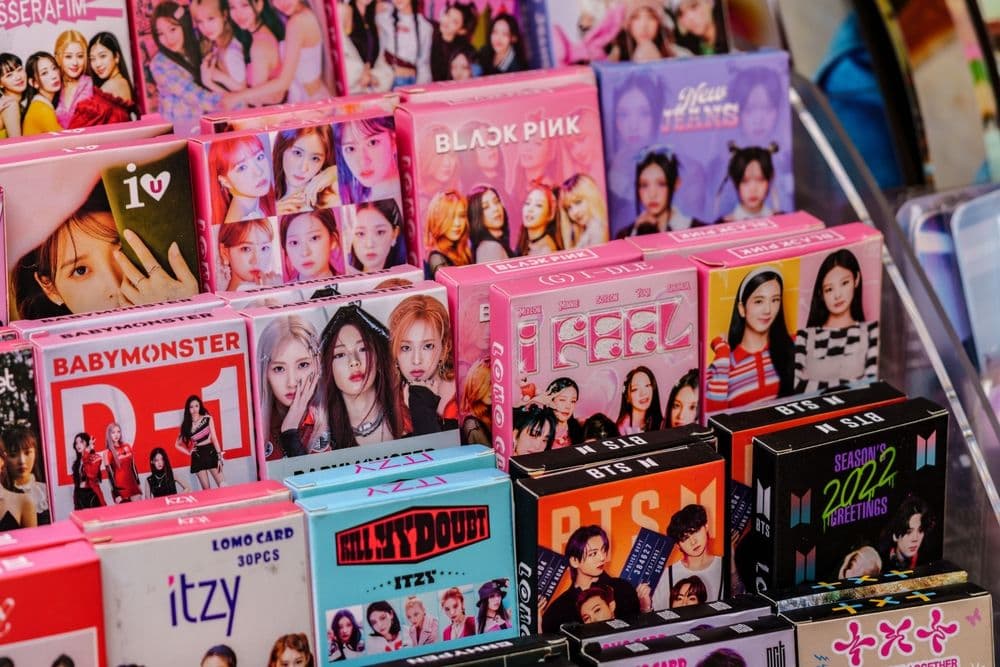
(G)I-DLE (Cube Entertainment, debuted 2018) occupies a generational borderland — technically late third generation by debut year, but artistically and commercially they have evolved into one of the fourth generation's most distinctive presences. Leader Soyeon's self-produced discography, including "Tomboy" (2022) and "Queencard" (2023), demonstrated a creative autonomy rare in the idol system and helped the group build a global following that reaches beyond the typical K-pop fanbase into mainstream pop and R&B audiences.
ITZY (JYP Entertainment, debuted 2019) brought an energy and a self-confidence to early fourth-generation concepts that was influential in establishing the generation's initial aesthetic identity. Their debut track "DALLA DALLA" announced a group that wasn't interested in softness or deference, and their sustained output across multiple years has kept them among the generation's most consistent performers.
NMIXX (JYP Entertainment, debuted 2022) is the group most aggressively committed to genre experimentation. Their "mixx pop" concept — tracks that shift genres multiple times within a single song — is either the most exciting or the most challenging thing happening in fourth-generation music depending on who you ask, and that tension is, arguably, part of the point. Their 2024 output showed a group growing more assured in executing an ambitious concept.
BABYMONSTER (YG Entertainment, debuted 2024) is the newest major player in the fourth-generation field, and their arrival generated extraordinary anticipation — partly due to the YG pedigree and partly because of the nearly two-year gap between their announced formation and their actual debut. Their seven-member lineup, combining Korean, Japanese, and Thai members, carries significant multilingual appeal, and their early releases have placed them immediately within the conversation about who leads the next wave.
tripleS (Modhaus, debuted 2023) represents one of the more radical experiments in K-pop's new era: a 24-member group whose subunit configurations and activities are partially determined by fan voting, creating a participatory model of idol group management that inverts some of the fundamental assumptions of the traditional agency system.
ㅤㅤㅤ
What Makes This Generation Different: Three Defining Shifts
From Uniform to Individual
Third-generation girl groups were largely defined by group cohesion — the unit identity was primary, individual member identities secondary. Fourth-generation groups, particularly the most successful ones, invert this. Members have distinct personal aesthetics, fan followings, and solo activities that run parallel to group schedules. The group is a constellation of distinct personalities rather than a unified brand image. This makes individual members more internationally portable and the overall group more resilient to lineup changes — but it also requires agencies to manage far more complex fan relationship dynamics simultaneously.
From Korea-First to Global-Simultaneous
Third-generation acts typically established Korean success first, then leveraged it internationally. Fourth-generation acts are, increasingly, designed for simultaneous global release from day one. International members — Japanese, Chinese, Thai, American — are not additions to a Korean core concept but co-architects of it. This fundamentally changes how concepts, lyrics, and promotion strategies are developed, and it produces groups that feel less like Korean exports and more like genuinely multinational creative projects.
From Fandom-Driven to Broadly Streamed
Perhaps the most significant commercial shift: fourth-generation girl groups are achieving chart placements through broad organic streaming rather than exclusively through coordinated fan campaign activity. When IVE or aespa or LE SSERAFIM appear on global Spotify charts, the numbers frequently reflect casual and mainstream listeners alongside dedicated fans. This broader streaming base is what makes the strongest fourth-generation acts genuinely competitive in global pop — not just within the K-pop ecosystem, but in the wider chart conversation.
ㅤㅤㅤ
Why the Fourth Generation Matters Beyond K-Pop
There is a broader cultural story embedded in the fourth generation's rise, and it is worth naming.
The acts dominating K-pop's fourth generation are not simply making excellent pop music — though many of them are. They are demonstrating, at scale and with increasing commercial sophistication, that the global music industry's center of gravity has permanently shifted. The playlist of what "global pop" sounds like, looks like, and conceptually reaches for is no longer defined primarily by English-language acts from the US and UK.
The fourth-generation girl groups have played a specific and central role in this shift. They have done it not by imitating Western pop but by developing an aesthetic language that is unmistakably Korean in its influences, production values, and conceptual frameworks — and discovering that this specificity, rather than limiting their global appeal, is precisely what generates it.
In a music landscape increasingly defined by algorithmic homogenization — everything softened and optimized for the widest possible audience — K-pop's fourth generation has bet on distinctiveness. The groups that have pushed hardest on their own specific visions: aespa's AI mythology, IVE's studied cool, LE SSERAFIM's physical fearlessness, (G)I-DLE's creative autonomy — are the groups that have traveled furthest.
The lesson is not unique to K-pop. But K-pop's fourth generation is making the argument more visibly than almost anyone else in contemporary music right now.
ㅤㅤㅤ
Looking Ahead
The fourth generation is not finished arriving. Groups that debuted in 2023 and 2024 are still finding their footing. Concepts that feel fresh today will evolve — some in directions that sustain and amplify, others in directions that surprise even their most dedicated fans.
What is already clear is that the fourth generation's girl groups have established a standard of ambition — conceptually, sonically, visually, globally — that raises the bar for everyone entering the space. The artists leading this generation are not coasting on K-pop's accumulated global momentum. They are actively expanding what K-pop can be.
That is, ultimately, what every generation worth paying attention to does.
And this one is very much worth paying attention to.
ㅤㅤㅤㅤㅤㅤ
ㅤㅤㅤㅤㅤㅤ
#KPopGirlGroups #4thGenKpop #aespa #IVE #LESSERAFIM #NewJeans #KPop2026 #KPopMusic #KPopChart #GirlGroupSzn